Saturday, March 22, 2014

Flower


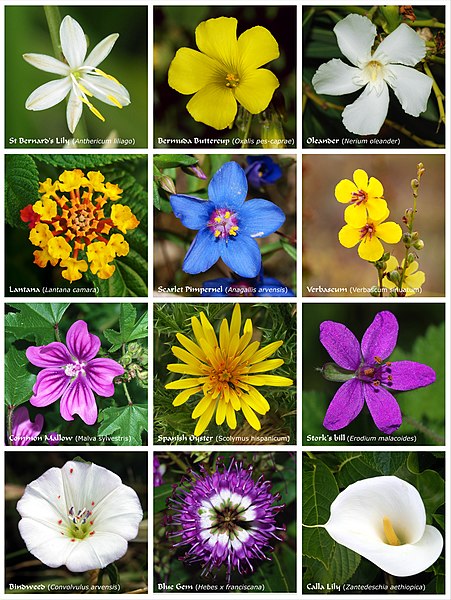
File:Flower poster 2.jpgA flower, sometimes known as a bloom or blossom, is the reproductive structure found in flowering plants (plants of the division Magnoliophyta, also called angiosperms). The biological function of a flower is to effect reproduction, usually by providing a mechanism for the union of sperm with eggs. Flowers may facilitate outcrossing (fusion of sperm and eggs from different individuals in a population) or allow selfing (fusion of sperm and egg from the same flower). Some flowers produce diaspores without fertilization (parthenocarpy). Flowers contain sporangia and are the site where gametophytes develop. Flowers give rise to fruit and seeds. Many flowers have evolved to be attractive to animals, so as to cause them to be vectors for the transfer of pollen.
In addition to facilitating the reproduction of flowering plants, flowers have long been admired and used by humans to beautify their environment, and also as objects of romance, ritual, religion, medicine and as a source of food.


Parts of a Flower


The Female Reproductive Organs:

The pistil is the collective term for the carpel(s). Each carpel includes an ovary (where the ovules are produced; ovules are the female reproductive cells, the eggs), a style (a tube on top of the ovary), and astigma (which receives the pollen during fertilization).

The Male Reproductive Organs:

Stamens are the male reproductive parts of flowers. A stamen consists of an anther (which produces pollen) and a filament. The pollen consists of the male reproductive cells; they fertilize ovules.

Fertilization:

Pollen must fertilize an ovule to produce a viable seed. This process is called pollination, and is often aided by animals like bees, which fly from flower to flower collecting sweet nectar. As they visit flowers, they spread pollen around, depositing it on some stigmas. After a male's pollen grains have landed on the stigma during fertilization, pollen tubes develop within the style, burrowing down to the ovary, where the sperm fertilizes an ovum (an egg cell), in the ovule. After fertilization, the ovule develops into a seed in the ovary.
Types of Flowers:

Some flowers (called perfect flowers) have both male and female reproductive organs; some flowers (called imperfect flowers) have only male reproductive organs or only female reproductive organs. Some plants have both male and female flowers, while other have males on one plant and females on another. Complete flowers have stamens, a pistil, petals, and sepals. Incomplete flowers lack one of these parts.

Leaf


A leaf is an organ of a vascular plant, as defined in botanical terms, and in particular in plant morphology. Foliage is a mass noun that refers to leaves as a feature of plants.[1][2]
Typically a leaf is a thin, flattened organ borne above ground and specialized for photosynthesis, but many types of leaves are adapted in ways almost unrecognisable in those terms: some are not flat (for example many succulent leaves and conifers), some are not above ground (such asbulb scales), and some are without major photosynthetic function (consider for example cataphylls, spines, and cotyledons).
Conversely, many structures of non-vascular plants, or even of some lichens, which are not plants at all (in the sense of being members of the kingdom Plantae), do look and function much like leaves. Furthermore, several structures found in vascular plants look like leaves but are not totally homologous with leaves; they differ from typical leaves in their structures and origins. Examples include phyllodes, cladodes, andphylloclades.[2][3]
According to Agnes Arber's partial-shoot theory of the leaf, leaves are partial shoots.[4] Compound leaves are closer to shoots than simple leaves. Developmental studies have shown that compound leaves, like shoots, may branch in three dimensions.[5][6] On the basis of molecular genetics, Eckardt and Baum (2010) concluded that "is is now generally accepted that compound leaves express both leaf and shoot properties."


Parts of a leaf


The Blade, or lamina, is the broad, flat part of the leaf. Photosynthesis occurs in the blade, which has many green food-making cells. Leaf blades differ from one another in several ways: (1) the types of edges, (2) the patterns of the veins, and (3) the number of blades per leaf.
The Types of Edges. Almost all narrow, grasslike leaves and needles leaves have a blade with a smooth edge, as do many broadleaf plants, particularly those that are native to warm climates. The rubber plant, a common house plant, is a good example of such a plant.
The leaves of many temperate broadleaf plants have small, jagged points called teeth along the blade edge. Birch and elm trees have such leaves. Some plants havehydathodes, tiny valvelike structures that can release excess water from the leaf. The teeth of young leaves on many plants, including cottonwood and pin cherry trees, bear tiny glads. These glands produce liquids that protect the young leaf from plant-eating insects.

Some temperate broadleaf plants -- including sassafras trees and certain mulberry and oak trees -- have lobed leaves. The edge of such a leaf looks as if large bites have been taken out of it. This lobing helps heat escape from the leaf.
The Patterns of the Veins. Veins carry food and water in a leaf. They also support the blade, much as the metal ribs support the fabric of an open umbrella.
In most broad leaves, the veins form a netlike pattern, with several large veins connected by smaller ones. The smallest veins supply every part of the blade with water. They also collect the food made by the green cells.
There are two main types of net-vein patterns -- pinnate (featherlike) and palmate (palmlike or handlike). Pinnately veined leaves have one large central vein, called the midrib, which extends from the base of the blade to its tip. Other large veins branch off on each side of the midrib. The leaves of beech, birch, and elm trees have such a vein pattern. A palmately veined leaf has several main veins of about equal size, all of which extend from a common point at the base of the blade. The vein patterns of maple, sweet gum, and sycamore leaves are palmate.
Narrow leaves and needle leaves are not net-veined. Narrow leaves have a parallel-vein pattern. Several large veins run alongside one another from the base of the blade to the tip. Small crossveins connect the large veins. Needle leaves are so small that they have only one or two veins running through the center of the blade.

The Petiole is the stemlike part of the leaf that joins the blade to the stem. Within a petiole are tiny tubes that connect with the veins in the blade. Some of the tubes carry water into the leaf. Others carry away food that the leaf has made. In many trees and shrubs, the petioles bend in such a way that the blades receive the most sunlight, thus assuring that few leaves are shaded by other leaves. The petiole also provides a flexible "handle" that enables the blade to twist in the wind and so avoid damage.
In some plants, the petioles are much larger than the stems to which they are attached. For example, the parts we eat of celery and rhubarb plants are petioles. In contrast, the leaves of some soft-stemmed plants, particularly grasses, have no petioles.
The Stipules are two small flaps that grow at the base of the petiole of some plants. In some plants, the stipules grow quickly, enclosing and protecting the young blade as it develops. Some stipules, such as those of willows and certain cherry trees, produce substances that prevent insects from attacking the developing leaf.

In many plants the stipules drop off after the blade has developed, but garden peas and a few other kinds of plants have large stipule.


Plant stem


           A stem is one of two main structural axes of a vascular plant, the other being the root. The stem is normally divided into nodes and internodes. The nodes hold buds which grow into one or more leaves, conifer cones, roots, other stems, or flowers (inflorescences); the internodes distance one node from another. The term "shoots" is often confused with "stems"; "shoots" generally refers to new fresh plant growth including both stems and other structures like leaves or flowers. In most plants stems are located above the soil surface but some plants have underground stems. A stem develops buds and shoots and usually grows above the ground. Inside the stem, materials move up and down the tissues of the transport system.Stems are often green.Stems have thin pipes to carry water around the plant.Stem consists of xylem and phloem tissue.
Stems have four main functions which are:[1]
  • Support for and the elevation of leaves, flowers and fruits. The stems keep the leaves in the light and provide a place for the plant to keep its flowers and fruits.
  • Transport of fluids between the roots and the shoots in the xylem and phloem.
  • Storage of nutrients.
  • Production of new living tissue. The normal life span of plant cells is one to three years. Stems have cells called meristems that annually generate new living tissue.

Parts of a Stem


  • Branch/lateral growth/side shoot

These different terms are all used to describe stems which come out of the main stem. Generally this growth is slightly slimmer than the main stem or ‘trunk’ of the plant.
  • Node

Nodes are areas of growth. These parts of the stem contain a lot of cells which are called ‘meristematic‘; cells which actively divide to create lots of new cells. Nodes are where you will find buds, side shoots, leaves and flowers growing. Nodes are important when propagating plants by stem cuttings.
  • Internode

This is the space between two nodes. It is the area which extends to give the stem more length and, therefore, the plant more height. It is also known as the ‘internodal’ area.
  • Axillary bud

These are buds which form in the axils between a stem and a side shoot, or between a stem and a leaf. These buds may remain dormant or may develop into a side shoot, leaf or flower.
  • Apical bud

This type of bud is found at the tip of stems and denotes a strongly meristematic area, ie an area where cells are actively dividing and, therefore, lengthening the stem. At these apical growth points there is a build up of a hormone called auxin, which controls the growth. The heightened levels of auxin at the tips of stems inhibits the axillary buds (this is called ‘apical dominance’) and is the reason why they often remain dormant. When we prune plants we remove the apical buds, which encourages more growth from the axillary buds. This is why plants often become more bushy with pruning .